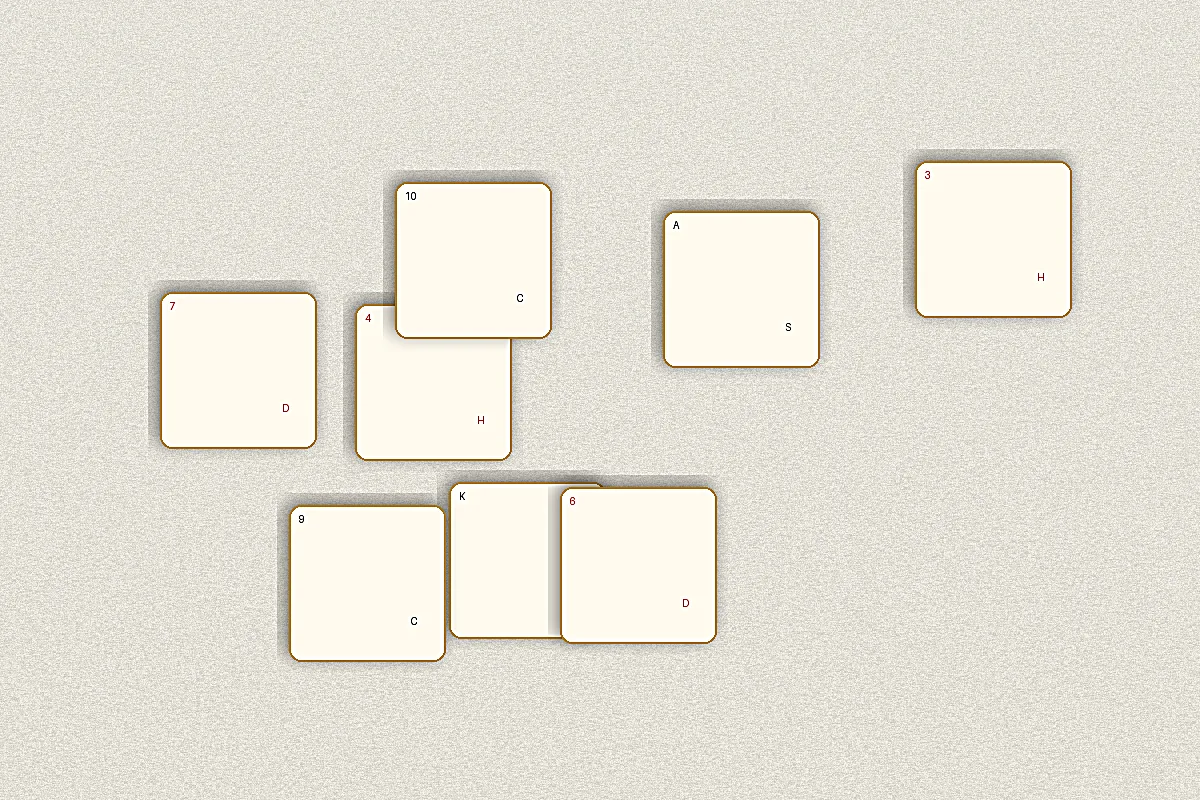
Every player meets rummy through a format, and the format quietly decides almost everything else: how long the table sits, how much a mistake costs, and how much the skill ceiling matters. We treat the four common formats as four different rooms in the same house. The furniture is similar. The acoustics, the lighting and the way a hand ends are not.
This note walks through each format, describes the texture of a real session, and ends with a comparison ledger and a short decision guide. It is a companion to How to Play, which assumes you have chosen a format and explains the first hand. It is also a companion to Strategy, which works through the habits that hold up across formats.
01 · Points Rummy
Points Rummy is the cleanest door into the house. Each hand is independent, scores are tallied at the end, and the winner is the player who declares a valid hand while paying the least in unmatched-card value. A typical hand runs three to six minutes.
The Points format is also the cleanest place to practise the four habits in Strategy. Drop early when the hand is dead, hold the pure sequence, read the discard pile, and use the joker deliberately. None of these habits depends on the format, but the format makes them visible.
A working session of Points Rummy reveals two texture patterns worth naming. The first is the rhythm of the hand: the timer resets on your turn, the table waits on a single discard, and the open pile begins to look like a script as the hand unfolds. The second is the variance shape: a single bad drop costs you the first-turn fee; a single good declaration wins the pot outright; the rest of the variance is in the middle.
The Points format is also the cleanest place to practise the four habits in Strategy. Drop early when the hand is dead, hold the pure sequence, read the discard pile, and use the joker deliberately. None of these habits depends on the format, but the format makes them visible.
A working session of Points Rummy reveals two texture patterns worth naming. The first is the rhythm of the hand: the timer resets on your turn, the table waits on a single discard, and the open pile begins to look like a script as the hand unfolds. The second is the variance shape: a single bad drop costs you the first-turn fee; a single good declaration wins the pot outright; the rest of the variance is in the middle.
The skill ceiling in Points is moderate but real. The session rewards two specific habits: knowing when a hand is dead and dropping early, and reading the open discard pile as a script that other players are writing in real time. We work through both habits in Strategy.
02 · Pool Rummy
Pool Rummy removes the per-hand reset. Players carry their cumulative score across hands, and the first player to cross a fixed elimination threshold is knocked out. A 101 Pool session can run an hour; a 201 Pool session, an evening.
The longer arc also changes what a good declaration looks like. A declaration that wins a single hand but costs you three drops earlier in the evening is a net negative. The arithmetic matters; the skill is in keeping the arithmetic on your side.
Pool 101 and Pool 201 are not just longer hands of the same game. They are different games because the stakes accumulate across hands. A player who bleeds points slowly across an evening is the player who survives the longest session; a player who hits the elimination threshold early has paid for the table time of the other three.
The longer arc also changes what a good declaration looks like. A declaration that wins a single hand but costs you three drops earlier in the evening is a net negative. The arithmetic matters; the skill is in keeping the arithmetic on your side.
Pool 101 and Pool 201 are not just longer hands of the same game. They are different games because the stakes accumulate across hands. A player who bleeds points slowly across an evening is the player who survives the longest session; a player who hits the elimination threshold early has paid for the table time of the other three.
The longer arc changes what a good hand looks like. A player who drops too often bleeds points slowly; a player who holds near-miss sequences too long bleeds points quickly. The skill ceiling is high, and the variance session to session is wider than in Points, so a budget conversation becomes part of the format itself. We cover that in Responsible Play.
03 · Deals Rummy
Deals Rummy fixes the number of deals in advance. Each player plays a fixed number of deals (commonly two or three), and the player with the lowest cumulative score at the end wins. The format sits between Points and Pool in length and rewards consistent, low-variance decision-making.
Deals rummy introduces a small but important variable: the joker can land in any deck position across the session, and the player who reads its movement best has an information advantage. Two-deck Deals in particular rewards players who track the joker across the full deals schedule.
Deals rummy introduces a small but important variable: the joker can land in any deck position across the session, and the player who reads its movement best has an information advantage. Two-deck Deals in particular rewards players who track the joker across the full deals schedule.
The Deals format is also where the two-deck variant lives. Two decks make higher-value melds possible, slow the table slightly, and reward players who track the discard pile across multiple deals.
04 · Tournaments
A rummy tournament is a structured event with a fixed entry, a fixed prize pool, and a fixed start. Tournaments run on Points rules inside, but the meta-game changes everything: chip survival matters more than hand quality, and a clean drop in the first round can be worth more than a heroic declaration in the last.
Tournament rummy is the format most working adults should approach with caution. The entry fee is fixed, the prize pool is fixed, and the duration is fixed; what is not fixed is the number of hands you will play and the variance you will face. A working adult with a session budget may be better served by a Pool 101 session than a tournament entry, and that is a choice the platform should let you make without pressure.
Tournament rummy is the format most working adults should approach with caution. The entry fee is fixed, the prize pool is fixed, and the duration is fixed; what is not fixed is the number of hands you will play and the variance you will face. A working adult with a session budget may be better served by a Pool 101 session than a tournament entry, and that is a choice the platform should let you make without pressure.
05 · The comparison ledger
The table below scores each format on the dimensions that actually change a session. Numbers are typical for regulated Indian platforms and may shift with regional rules, table size and operator-specific variants.
> e d i s a / < > p / < . g n i k n a r l a n i f a t o n , l o o t g n i k r o w a s i e l b a t e h T . y l k e e w s t n e m a n r u o T s y a l p o h w r e d a e r a m o r f y l t n e r e f f i d e l b a t e h t d a e r l l i w y l l a n o i s a c c o 1 0 2 l o o P d n a y l k e e w y m m u R s t n i o P s y a l p o h w r e d a e r A . s t a m r o f e h t e r a s w o r e h t ; n o i s s e s a e g n a h c t a h t s n o i s n e m i d e h t e r a s n m u l o c e h T > p < > g n o r t s / < r e g d e l e h t d a e r o t w o H > g n o r t s < > " d r a c - o f n i " = s s a l c e d i s a <The ledger is a starting point, not a final word. The relative ranking of formats depends on the player; a working adult with a fixed budget and a quiet evening will rank Pool 101 above a Tournament in practice, regardless of where the format appears in the table.
> e d i s a / < > p / < . g n i k n a r l a n i f a t o n , l o o t g n i k r o w a s i e l b a t e h T . y l k e e w s t n e m a n r u o T s y a l p o h w r e d a e r a m o r f y l t n e r e f f i d e l b a t e h t d a e r l l i w y l l a n o i s a c c o 1 0 2 l o o P d n a y l k e e w y m m u R s t n i o P s y a l p o h w r e d a e r A . s t a m r o f e h t e r a s w o r e h t ; n o i s s e s a e g n a h c t a h t s n o i s n e m i d e h t e r a s n m u l o c e h T > p < > g n o r t s / < r e g d e l e h t d a e r o t w o H > g n o r t s < > " d r a c - o f n i " = s s a l c e d i s a <The ledger is a starting point, not a final word. The relative ranking of formats depends on the player; a working adult with a fixed budget and a quiet evening will rank Pool 101 above a Tournament in practice, regardless of where the format appears in the table.
| Format | Hand length | Skill ceiling | Variance | Best for |
|---|---|---|---|---|
| Points | 3–6 min | Moderate | Low | First sessions, short breaks |
| Pool 101 | 45–75 min | High | Medium | Longer evenings with a fixed stake |
| Pool 201 | 90–120 min | High | Medium | Quiet weekends with a clear budget |
| Deals (2-deck) | 25–40 min | High | Medium | Players who like rhythm and structure |
| Tournament | 30–90 min total | Very high | High | Players who enjoy the meta-game |
06 · Choosing a first format
If you have never played rummy on a regulated platform, start with Points Rummy. The hand is short, the rules fit on a single page, and the cost of a mistake is bounded. If you already play and want a longer arc with a fixed stake, try Pool 101. If you have a quiet evening and a clear budget, Pool 201 is the format most working adults choose for a Saturday.
A first session should feel mechanical, not theatrical. Points Rummy has the shortest rulebook, the shortest hands and the cheapest mistakes. Start there; move to Pool when the table and the platform have both earned your trust.
A first session should feel mechanical, not theatrical. Points Rummy has the shortest rulebook, the shortest hands and the cheapest mistakes. Start there; move to Pool when the table and the platform have both earned your trust.
Whichever format you pick, run through Safety and Verification once. A platform that hides its verification flow or makes withdrawal timing vague is not the right platform for a long arc, regardless of format.
07 · Common questions
Which format pays the most per hour?
None of them pay reliably per hour. The honest answer is that rummy is skill-dominant but variance is real, and a session’s return depends on the decisions you make over many sessions, not on the format itself.
Is two-deck rummy harder than one-deck?
The rules add a small amount of complexity (more jokers, slightly different meld value) but the core skill is the same. The difference you will feel is in pace: two-deck hands run a little longer and the discard pile becomes more informative.
How do I move from Points to Pool without overspending?
Set a fixed session budget in advance, drop early when the hand is dead, and stop at the session limit regardless of the score. Responsible Play walks through the workflow in plain language.
This read is part of the editorial edition. The companion notes are How to Play a Hand, Strategy Boundaries and Platform Reviews.